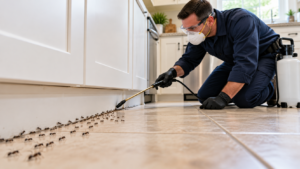
The ants travelling across a kitchen floor or countertop may represent only a small portion of a much larger colony.
Worker ants leave the nest to search for food and water. Once a food source is located, many species establish chemical trails that allow other workers to follow the same route. Killing the visible workers may temporarily reduce activity without eliminating the nest or queen.
Several ant species can become structural or nuisance pests. Correct identification matters because their nesting behaviour and preferred food can differ considerably.
Carpenter ants
Carpenter ants excavate galleries in wood to create nesting space. They do not eat wood, but colonies established in structural wood can cause damage over time. Moisture-damaged or deteriorated wood can be particularly attractive for nesting.
Pavement ants
Pavement ants commonly establish colonies around foundations, beneath concrete, along sidewalks and in other protected soil locations. Workers may enter buildings while searching for food.
Pharaoh ants
Pharaoh ants are very small and can establish colonies in warm, protected indoor locations. They can be particularly difficult to control in multi-unit and institutional buildings because inappropriate treatment can disperse colonies and worsen the infestation.
Other ant species may also enter Alberta homes and businesses, making identification an important first step.
For many ant infestations, appropriately selected bait takes advantage of the ants’ own feeding behaviour.
Worker ants collect the bait and may transfer it to other members of the colony. Because the active ingredient works gradually, the treatment can reach ants that never leave the nest.
The effectiveness of bait depends on several factors, including the ant species, food preference, bait formulation, competing food sources and placement.
Indiscriminate use of repellent insecticides can sometimes interfere with baiting and, with certain ant species, may contribute to colony dispersal.
Our ant-control process begins with identification and inspection, not simply spraying the ants that are visible.
Depending on the species and site conditions, the program may include:
If ants repeatedly return after being sprayed, the problem may not be the ants you can see—it may be the colony you cannot.

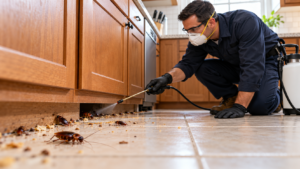
Let NorthPoint find the nest and wipe out the colony.

Professional residential and commercial pest management solutions serving Edmonton and surrounding Alberta communities.
Protect your home from cockroaches, ants, rodents, bed bugs, and more with professional Integrated Pest Management and targeted control treatments.
WhatsApp us